Thursday, November 12, 2009

Wp2:rough draft 2


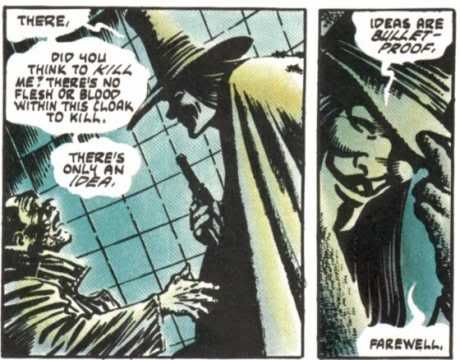
The Comic I chose was an excerpt from the Graphic Novel V for Vendetta by Alan Moore, and David Lloyd. The Graphic novel itself is one about freedom and revolution. It depicts the main hero of the graphic novel, V, and he is standing holding a man who is just trying to kill him. He makes a statement about how there is not, “flesh and blood under his robes, there is only an idea”. Then he goes on to state that, “Ideas are bullet proof.” The comics compiled to make this novel was published from 1982-1989. I think through the rhetoric terms of the abstract concepts and realistic representation of V’s facial region, whether it is the complexity of the artwork, or the simplicity of the mask V is wearing. There is also the aspect of the allegory of V not being a human but an idea, cement the main purpose of the comic. That Ideas and concepts cannot be killed bullets and force.

One of the most critical arguments in the comic would have to be the realistic representation of V’s facial region. There are many abstractions and many different rhetoric terms that lie in the facial region. A think this is so the author can add legitimacy to his argument. A lot of times we see comics that have drawings that are more cartoonish. I think the author wanted to stay away from that because the message he wasn’t to portray needs to be taken seriously. The face that he stays away from that cartoonish type of drawing makes the audience see the comic in a more serious light.

I notice another point being made in the comic when I compare V’s face to the face of the man he is holding in the first panel. The man’s face in the first panel seems very complex and very detailed. V’s face though complex, doesn’t have as much detail as man that he is holding. I this is so that no matter who the audience is, we can see ourselves in the face of V. In the Mccloud essay, we try and see ourselves in almost everything. This is apparent in the comic, the author wants us to be able to relate to the main character, and for us to accept the idea that he is trying to implement.


The concept of V not being a person, but embodying and idea, is an excellent example of an allegory. This is a very interesting concept; I think that the author put this in so that they can cement their idea of an idea being indestructible. You see in the first panel that V declares that he is not made of flesh and blood, but an idea. While he is saying this you see what looks like a gun. It is apparent at this point that the man he is holding in the comic was trying to kill him. As you can tell he is unsuccessful, but V reiterates the fact that an idea cannot be killed through those conventional methods. V himself embodies the idea, but even if he was killed, the idea would continue to live on and exist. V is like a symbol to the idea, not the idea itself.

V’s words and face make him seem like he is not human, like he is just an idea. When you look at the comic you will notice that V’s face is mostly in shadows. In the second panel you can see his eyes; they are engulfed in darkness which adds to this illusion of him being almost inhuman. This style almost embodies idea’s themselves. An idea isn’t always straight forward and clear. Like I have stated before ideas themselves are complex. The mystery surrounding the hero of this comic only embodies it through the shadows surrounding his face.

The word bubbles themselves add the concept that V is almost not human. In most comics when someone is talking you have your basic world bubble; it is a basic oval, or circle. Then you also have your basic thought bubble, which is that of the shape of a cloud. When V is speaking in the comic his bubble is neither. It looks like it is a combination of the two, like what he is saying isn’t exactly word, but isn’t exactly thought. It adds to the allegory that V is not necessarily supposed to embody a human, but an idea. This idea that he is embodying isn’t necessarily physical, so it doesn’t deserve the regular word bubble that we see in most comics.


This symbolism inspires rhetorical terms, one of those being pathos specifically hope. Because V says that an idea cannot be killed or destroyed by bullets, this makes you the audience hopeful for the ideas that you have yourself. It gives you hope that even if some people try and stomp out your idea, that your ideas are too powerful for one person to try and destroy. Your ideas can live on, and be there to inspire others to initiate them and carry them through.

There is also a unique way the author bolds and italicized some aspects of the comic. The words “Kill”,”Idea”, and, “Bulletproof”, are all italicized and bold. This makes you look at these words first. Since the author chose to do this, there is more emphasis on these words themselves. It makes the words more important. Since all these words are part of the main argument that the author is trying to make, it is important they are written the way they are. It helps add legitimacy to the argument, and drives it home, making sure it stays with the audience

We don’t even have to look very far in history to see how this comic can relate. Many different wars and conflicts where caused by ideas, and a lot of times these ideas were never killed a carried on till this day. One that is apparent to me and, is still being practiced today is the idea of communism. When this comic was made communism was in full swing in Russia, and many people did not like the idea. When the communism was finally finished in Russia, the idea did not die here. The idea of communism was not destroyed and is still practiced in countries today.

In the end I think it is clear that the statement of purpose is achieved. This idea of an idea being bulletproof should be taken into consideration when one is coming up with ideas. One should not be scared about an idea no matter what the circumstances. You need to stand up and take a chance on your idea. People may be against and you may even be punished, but just know that how hard they might try, your idea will not be killed. If you look at examples through many different revolutions over the course of time, you can see that a lot of those ideas have been used and carried on today. Your idea will carry on, and hopefully one day achieved.

Monday, November 9, 2009

Wp2:rough draft


The Comic I chose was an excerpt from the Graphic Novel V for Vendetta by Alan Moore, and David Lloyd. The Graphic novel itself is one about freedom and revolution, so it makes sense why the excerpt I have is in the novel itself. It depicts the main hero of the graphic novel, V, and he is standing holding a man who is just trying to kill him. He makes a statement about how there is not, “flesh and blood under his robes, there is only an idea”. Then he goes on to state that, “Ideas are bullet proof.” The comics compiled to make this novel was published from 1982-1989. During this time there was the struggle of the cold war, and many ideas of communism and freedom. I think through the rhetoric terms of the abstract concepts and realistic representation of V’s facial region, and the allegory of V not being a human but an idea, cement the main purpose of the comic. That Ideas and concepts cannot be killed bullets and force.


One of the most critical arguments in the comic would have to be the realistic representation of V’s facial region. There are many abstractions and many different rhetoric terms that lie in the facial region. As we see V’s face is more complex than what we normally see in most comics and cartoons. I believe that this is because the author wants to convey that an idea itself is very complex. The concept of an idea has many parts, and most of the time and some are very difficult to be broken down. This complexity is here because the author wants you to know how difficult it is for an idea to be destroyed.

I notice another point being made in the comic when I compare V’s face to the face of the man he is holding in the first panel. The man’s face in the first panel seems very complex and very detailed. V’s face though complex, doesn’t have as much detail as man that he is holding. I this is so that no matter who the audience is, we can see ourselves in the face of V. In the Mccloud essay, we try and see ourselves in almost everything. This is apparent in the comic, the author wants us to be able to relate to the main character, and for us to accept the idea that he is trying to implement.

The concept of V not being a person, but embodying and idea, is an excellent example of an allegory. This is a very interesting concept; I think that the author put this in so that they can cement their idea of an idea being indestructible. You see in the first panel that V declares that he is not made of flesh and blood, but an idea. While he is saying this you see what looks like a gun. It is apparent at this point that the man he is holding in the comic was trying to kill him. As you can tell he is unsuccessful, but V reiterates the fact that an idea cannot be killed through those conventional methods. V himself embodies the idea, but even if he was killed, the idea would continue to live on and exist. V is like a symbol to the idea, not the idea itself.

V’s words and face make him seem like he is not human, like he is just an idea. When you look at the comic you will notice that V’s face is mostly in shadows. In the second panel you can see his eyes; they are engulfed in darkness which adds to this illusion of him being almost inhuman. This style almost embodies idea’s themselves. An idea isn’t always straight forward and clear. Like I have stated before ideas themselves are complex. The mystery surrounding the hero of this comic only embodies it through the shadows surrounding his face.

The word bubbles themselves add the concept that V is almost not human. In most comics when someone is talking you have your basic world bubble; it is a basic oval, or circle. Then you also have your basic thought bubble, which is that of the shape of a cloud. When V is speaking in the comic his bubble is neither. It looks like it is a combination of the two, like what he is saying isn’t exactly word, but isn’t exactly thought. It adds to the allegory that V is not necessarily supposed to embody a human, but an idea. This idea that he is embodying isn’t necessarily physical, so it doesn’t deserve the regular word bubble that we see in most comics.


This symbolism inspires rhetoric terms, one of those being pathos specifically hope. Because V says that an idea cannot be killed or destroyed by bullets, this makes you the audience hopeful for the ideas that you have yourself. It gives you hope that even if some people try and stomp out your idea, that your ideas are too powerful for one person to try and destroy. Your ideas can live on, and be there to inspire others to initiate them and carry them through.

Another rhetoric term that must be addressed in the comic is that of logos. Since there are multiple panels in the comic, there is arrangement that progress the comic itself. The progression is also apparent in the writing itself. This logos seems to help solidify and strengthen the argument being made. V talks in the first frame and address the fact that he is not flesh and bone, and in the second he has his one liner about ideas being bulletproof. You see this in a lot of other comics involving heroes. They will make a statement, and then finish it up with a one liner. This is a very effective arrangement to get the point across and solidify it.

There is also a unique style and ethos to the writing in the comic. The words “Kill”,”Idea”, and, “Bulletproof”, are all italicized and bold. This type of ethos adds a unique style to the comic itself. Because the writer chose to do this, you get some extra emphasis on these words. Thus these words become more important in the writing and should be looked at more. It adds to the argument that you cannot kill an idea through bullets and conventional means.

We don’t even have to look very far in history to see how this comic can relate. Many different wars and conflicts where caused by ideas, and a lot of times these ideas were never killed a carried on till this day. One that is apparent to me and, is still being practiced today is the idea of communism. When this comic was made communism was in full swing in Russia, and many people did not like the idea. When the communism was finally finished in Russia, the idea did not die here. The idea of communism was not destroyed and is still practiced in countries today.


In the end I think it is clear that the statement of purpose is achieved. This idea of an idea being bulletproof should be taken into consideration when one is coming up with ideas. One should not be scared about an idea no matter what the circumstances. You need to stand up and take a chance on your idea. People may be against and you may even be punished, but just know that how hard they might try, your idea will not be killed. Your idea will carry on, and hopefully one day achieved.

Monday, November 2, 2009

WP2:Statement of Purpose


My comic is clearly one of inspiration and hope in dark times. I think that it is trying to state that one person doesn’t make the idea, the idea lives on in the people who believe, and that idea will live on through person to person. That idea is one of hope and freedom. The idea that one person can kill an idea is very foolish. As we have seen throughout history that the people who have inspired many different ideas might have died but, we can clearly see that this idea lives on in many different people. Sometimes this can be a bad thing, or a good thing.


My comic is coming from a historical context. One instance that truly sticks out to me is that of idea of hate, inspired during World War 2. We might have killed Hitler and his Social Darwinistic ideal of anti-Semitism, and a perfect race, but they still live on today. We still have people who call themselves neo-Nazi’s and still go around preaching hate and anti-Semitic ideas. Even though this isn’t the most happy of examples, it is still clear that even though the person who inspired the idea is dead, his idea still lives on in the people who believe in it.


I think that my target audience is going to be very diverse. I think that my audience is going to be one that has felt some type of unfair oppression or anyone who wants to think outside the box and rebel against injustice in their government. Because of this my comic will be viewed by basically anyone old or young. I think the cut off would probably have to be that of a teenager, my reasoning is that the subject manner would be too intense for someone younger than that. My audience will be that of any walk of life, because I think we have all experienced some type of injustice in our government or everyday lives.


I think that my comic will be read just about anywhere. Because it is a small part of a graphic novel, one of the most obvious places it will be read at will have to be a comic book store. Another place would have to be a library, because you can check out graphic novels at libraries. Last but not least my comic would have to be read on a computer, and this could be just about anywhere if you take into consideration laptops.


There are many good things that could come from my comic. I think that it could help some people change the way that they look at their lives and what they handle certain situations. I can see it inspiring people to stand up for their ideals and change their certain living condition. It could drastically change people’s lives for the better, and help them strengthen their ideals. There is also some negatives that can come from my comic and writing. I think some people can get angered by my comic and my paper.


There are many people out there that do not like to “stir the pot”. They like everything the way it is, and get angry when people try to challenge and change the way things are. I can see those people taking one look at the subject matter of my paper and rejecting my argument right off the bat. I think if I also bring up some times historically where some touching subjects come up in terms of ideas and they still living today, could anger some people. There are a lot of bad ideas out there that have not died that probably should have. I think these can sadden some people and turn them off to my paper.

Wednesday, October 28, 2009

WP2: second post

After I conducted research for my comic, I was able to see it in a whole new light. Since my comic is an excerpt from a graphic novel, I decided that it would be wise to read the whole novel itself. After reading it, I got a lot of insight about the story as a whole, and what exactly it was trying to portray. The historical context of this novel is almost that of communist Russia under Stalin. The setting of a futuristic London under a dictatorship rule definitely changed the way I perceive this comic and how I am going to analyze it.

One of the biggest misconceptions I had with my comic was that the main character was some sort of vigilante. That he was more of a terrorist with anarchy on the brain. I couldn’t have been more far off. V (the main character) is more of a fighter of freedom. He is one who fights against the dictatorship, because he believes that the people should live in a world where they can speak freely and think for themselves.

I think that this is the perfect type of medium to fight out against oppression and tyranny. I believe that the written word is a great way to get across ones opinion to many different types of people. I think that he chose a comic book hero to do this for obvious reasons. I think people look up to comic book heroes. They embody ourselves in a way that we wish we could be. People will listen to the author’s ideas, when they are spoken through that of a hero.

When I first started to talk and think through this comic, I was thinking of the concept of killing an “idea” as killing an idea like communism. I couldn’t have been more wrong. It wasn’t about killing some type of tyrannical idea; it was more about promoting ideals that we as humans all share. It was about promoting that idea of freedom. That we cannot kill our undeniable rights that we as humans where given when we were born.

Another thing I have reexamined my comic another thing stood out to me, the way certain words where bolded and italicized. At first I really didn’t know what to think about this. I thought it was more of an emphasis on key words with no real background to them. Once I read the novel itself, I learned more about the relationship between these two characters. V thinks that this man is no more than a monster. These words are emphasized because he hates this man. The man in the comic has caused him much pain, and now he is exacting his revenge that he has sought out so long ago.

In the end I think that this comic is the final result of a struggle of vengeance and freedom. The main character has been wronged, and he is now exacting his revenge. He has also been oppressed by a tyrannical government and is a victim. He no longer wants to see others suffer the same fate that he has seen others and himself face.

Works cited:

"Communist Party of the Soviet Union"Oct 28. 20010 <http://en.wikipedia.org/wiki/Communist_Party_of_the_Soviet_Union>

Moore, Alan, and David Lloyd.V for Vendetta.Us:Dc Comics, 1982

Italic


Monday, October 26, 2009

WP2: First Post


The comic that I chose is from graphic novel V for vendetta. The comic itself is about a masked vigilante, who decides that he isn’t going to take the unfair actions of his government anymore, and is going to rise and up inspire hope and anarchy in this alternate world. The panels I chose depicts the hero of the comic named V. In the two panels he is explained some of his philosophy that he has about people and an oppressive government. As I think through some of the content in chapter 15 in compose design advocate, it makes me think a lot about the content that is in the comic.


I think the aspect that we can understand a comic because of where we live, and what we have seen is extremely apparent in this comic. Because of history and what we have seen, what V is saying in this comic is very true. One example is the idea of communism. One might try and destroy the structure that has put the idea of communism into practice, but they can never really kill the idea itself. That idea will always live on the people who believe in it.


I think that the multiple panels of the comic are put together in a stereotypical, but effective way. With most comics I have seen, there are a lot of reoccurring themes. One that I have noticed is the dramatic statement made by a hero in a comic. There is always a buildup in one panel of the comic. Then in the next panel the hero drops a memorable line that sticks with the reader. A lot of times is will zoom in or make the hero the center of that panel.


This comic is no exception. We see V make is set up in the first panel, then drive it home with the memorable line “Ideas are bullet proof”. This really helps the flow between the two panels; you have the set up and the finisher. I also notice how idea in the first panel is in all capitals, and italicized. I think this emphasis on the word makes the comic flow. It makes you as an audience to read on and finish the comic.


The interactions between the characters in the comic are developed right off the bat of the comic. At first glance you can notice a gun, and V says “Did you think you can kill me.” Right off the bat you can tell that these two are not friends and are in fact enemies. If you look at the face of the other character, you can see what looks like shock, or fear. This leads you to believe that the man is scared or even intimidated by V. Finally the interaction is established with the closing statements of not being able to kill an idea. You might be able to kill a person, but the idea that he has inspired in people will be able to live on forever.